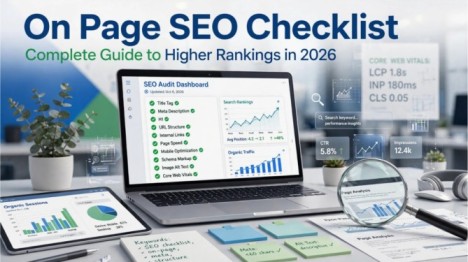
Search engine optimization has changed a lot over the years, but one thing has remained the same. If your pages are not properly optimized, they will struggle to rank no matter how many backlinks you build.
Many website owners focus only on off-page SEO and forget that on-page SEO creates the foundation for every successful SEO campaign. A well-optimized page helps search engines understand your content while giving visitors a better experience.
Whether you are a blogger, business owner, digital marketer, or SEO professional, following a proven on-page SEO checklist can improve your rankings, increase organic traffic, and boost conversions.
In this guide, you’ll learn every important on-page SEO factor that matters in 2026, along with practical tips you can apply immediately.
What Is On Page SEO?
On-page SEO is the process of optimizing individual web pages to improve their visibility in search engines and provide a better user experience.
Unlike off-page SEO, which focuses on backlinks and brand authority, on-page SEO includes everything you can control on your website, such as:
- Content quality
- Title tags
- Meta descriptions
- URL structure
- Headings
- Internal links
- Images
- Keyword optimization
- Page speed
- Mobile usability
- User experience
When these elements work together, search engines can better understand your content and rank it for relevant searches.
Why Is an On Page SEO Checklist Important?
Publishing content without optimization is like building a house without a foundation.
An effective on-page SEO checklist helps you:
- Improve keyword rankings
- Increase organic traffic
- Enhance user experience
- Reduce bounce rate
- Improve crawlability
- Boost click-through rates
- Support your link-building efforts
- Increase conversions
Every page you publish should go through this checklist before going live.
Complete On Page SEO Checklist
1. Start with Proper Keyword Research
Every successful page begins with the right keyword.
Instead of targeting keywords with high competition only, focus on search intent.
Look for:
- Primary keyword
- Secondary keywords
- Long-tail keywords
- Question-based keywords
- Semantic keywords
For this article, the primary keyword is:
On Page SEO Checklist
Related keywords include:
- On page SEO guide
- On page optimization
- SEO checklist
- Website optimization
- Technical SEO basics
Choose keywords that match what users are actually searching for.
2. Understand Search Intent
Google ranks pages that satisfy user intent.
Ask yourself:
- Does the user want information?
- Are they comparing options?
- Do they want to buy something?
- Are they looking for a tutorial?
Someone searching for an on-page SEO checklist expects practical steps, not lengthy theory.
Always solve the user’s problem first.
3. Write an SEO-Friendly Title
Your title is often the first thing people see in search results.
A good title should:
- Include the primary keyword
- Be under 60 characters when possible
- Encourage clicks
- Clearly explain the page
Example:
On Page SEO Checklist for Higher Rankings in 2026
4. Create a Compelling Meta Description
Although meta descriptions aren’t a direct ranking factor, they improve click-through rates.
A strong meta description should:
- Include the target keyword
- Stay between 145–155 characters
- Explain the page clearly
- Include a call to action
Think of it as an advertisement for your page.
5. Use Only One H1 Heading
Every page should have a single H1 heading.
This tells search engines the main topic of your content.
Use H2, H3, and H4 headings to organize the rest of your article naturally.
Proper heading structure also improves readability.
6. Keep Your URL Clean
A simple URL is easier for users and search engines.
Good example:
yourwebsite.com/on-page-seo-checklist
Avoid:
yourwebsite.com/blog?id=38473&page=seo-2026-guide-final
Short, descriptive URLs perform better.
7. Write Helpful, Original Content
Google rewards content that genuinely helps users.
Instead of repeating information found elsewhere, explain concepts using:
- Real examples
- Actionable advice
- Personal insights
- Updated information
Avoid fluff.
Answer the questions users actually have.
8. Place Your Primary Keyword Naturally
Keyword stuffing no longer works.
Instead, include your primary keyword naturally in:
- Title
- First paragraph
- H1
- Some H2 headings
- Conclusion
- Image alt text
- Meta description
- URL
Write for humans first.
9. Use Related Keywords
Search engines understand context better than ever.
Instead of repeating one keyword dozens of times, use related phrases.
Examples include:
- SEO optimization
- Search engine ranking
- Website optimization
- Organic traffic
- User experience
- Search visibility
This helps your page rank for multiple search terms.
10. Create Easy-to-Read Content
Visitors rarely read every word.
Make your content easier to scan by using:
- Short paragraphs
- Bullet points
- Numbered lists
- Clear headings
- Tables where appropriate
Better readability increases engagement.
11. Optimize Images
Images improve user experience but should also be optimized.
Compress large images before uploading.
Use modern formats when possible.
Choose descriptive filenames like:
on-page-seo-checklist.png
instead of
image001.jpg
12. Add Descriptive Alt Text
Alt text helps search engines understand images and improves accessibility.
Instead of:
image
Use:
On Page SEO Checklist infographic showing optimization steps
Keep alt text natural and descriptive.
13. Improve Internal Linking
Internal links help search engines discover more pages while keeping visitors engaged.
Link to relevant pages naturally.
For example, if your website offers SEO services, you can link to:
- Link Building Services
- Guest Posting Services
- SaaS Link Building Service
- SEO Blog Articles
A strong internal linking strategy distributes authority throughout your website.
14. Add Relevant External Links
Linking to trusted sources improves credibility.
Useful external references include:
Only link where it genuinely adds value.
15. Optimize for Featured Snippets
Featured snippets often appear above normal search results.
To improve your chances:
- Answer questions directly
- Use numbered lists
- Add bullet points
- Include comparison tables
- Keep definitions concise
Example:
What is On Page SEO?
On-page SEO is the practice of optimizing individual web pages to improve search engine rankings and user experience.
Simple answers like this often perform well.
16. Improve Page Speed
A slow website affects both rankings and conversions.
Improve speed by:
- Compressing images
- Using browser caching
- Reducing unnecessary scripts
- Using fast hosting
- Enabling lazy loading
Even a small improvement can make a noticeable difference.
17. Make Your Website Mobile Friendly
Most searches now happen on mobile devices.
Check that your pages:
- Display correctly
- Load quickly
- Have readable text
- Use responsive design
- Include clickable buttons
Google primarily indexes the mobile version of websites.
18. Focus on Core Web Vitals
Core Web Vitals measure user experience.
Pay attention to:
- Loading speed
- Visual stability
- Responsiveness
Improving these metrics often results in happier visitors and better rankings.
19. Add Schema Markup
Schema markup helps search engines understand your content.
Useful schema types include:
- Article
- FAQ
- Organization
- Breadcrumb
- Local Business
- Service
Schema can also improve your appearance in search results.
20. Add a Table of Contents
Long articles become easier to navigate with a table of contents.
Benefits include:
- Better user experience
- Easier navigation
- Higher engagement
- Potential sitelinks in search results
21. Write a Strong Introduction
Your introduction should immediately explain:
- What users will learn
- Why it matters
- What problem you’ll solve
Avoid unnecessary filler.
Get to the point quickly.
22. Keep Updating Your Content
SEO isn’t a one-time task.
Review your articles regularly.
Update:
- Statistics
- Screenshots
- Examples
- SEO recommendations
- Broken links
Fresh content often performs better over time.
23. Include a Clear Call to Action
Every page should guide visitors toward the next step.
Examples include:
- Contact your team
- Request an SEO audit
- Explore your services
- Read related articles
For businesses, a clear CTA can significantly improve conversions.
If you’re looking to improve your website’s rankings through high-quality backlinks and strategic SEO, Outsource Link Building offers professional guest posting and link-building services designed to support long-term organic growth. Combining strong on-page SEO with authoritative backlinks creates a more effective SEO strategy.
Common On Page SEO Mistakes
Avoid these mistakes that can limit your rankings:
- Keyword stuffing
- Duplicate content
- Missing meta descriptions
- Broken internal links
- Slow page speed
- Poor mobile experience
- Thin content
- Multiple H1 headings
- Unoptimized images
- Ignoring search intent
- Outdated content
- Weak internal linking
Fixing these issues can make a noticeable difference in your SEO performance.
Quick On Page SEO Checklist
| SEO Task | Complete |
| Keyword Research | ✅ |
| Search Intent | ✅ |
| SEO Title | ✅ |
| Meta Description | ✅ |
| H1 Tag | ✅ |
| Proper Headings | ✅ |
| Clean URL | ✅ |
| Helpful Content | ✅ |
| Keyword Placement | ✅ |
| Related Keywords | ✅ |
| Image Optimization | ✅ |
| Alt Text | ✅ |
| Internal Links | ✅ |
| External Links | ✅ |
| Featured Snippets | ✅ |
| Mobile Friendly | ✅ |
| Page Speed | ✅ |
| Core Web Vitals | ✅ |
| Schema Markup | ✅ |
| FAQ Section | ✅ |
| CTA | ✅ |
Frequently Asked Questions
What is on-page SEO?
On-page SEO is the process of optimizing individual web pages to improve their rankings in search engines while providing a better user experience.
Is on-page SEO still important in 2026?
Yes. On-page SEO remains one of the most important ranking factors because it helps search engines understand your content and improves user satisfaction.
How often should I update my on-page SEO?
Review important pages every few months or whenever Google’s algorithms change significantly. Regular updates help maintain rankings.
Does keyword density matter?
Not as much as it used to. Focus on writing naturally while covering the topic comprehensively rather than repeating the same keyword.
Which is more important, on-page SEO or backlinks?
Both are essential. On-page SEO ensures your pages are optimized, while quality backlinks increase authority. Together, they create a stronger SEO strategy.
Can I do on-page SEO without technical knowledge?
Yes. Many on-page SEO improvements, such as writing better content, optimizing headings, improving internal links, and adding descriptive meta tags, don’t require advanced technical skills.
Final Thoughts
A strong on-page SEO strategy is the foundation of sustainable organic growth. Before you think about backlinks or advanced SEO tactics, make sure every page on your website is fully optimized.
Use this on-page SEO checklist whenever you publish or update content. From keyword research and content optimization to page speed and user experience, each step contributes to better search visibility and higher rankings.
Once your pages are optimized, combining them with a high-quality link-building strategy can help accelerate your SEO results. At Outsource Link Building, we help businesses strengthen their online presence through ethical guest posting and authoritative backlink services that complement a solid on-page SEO foundation.
Whether you’re optimizing your first blog post or managing a large business website, following this checklist consistently will put you on the right path toward long-term SEO success.