If you’ve spent any time in SEO, you already know backlinks aren’t optional; they’re one of the clearest trust signals search engines use to decide who deserves to rank. But “get more backlinks” is vague advice. The real skill is link acquisition: a deliberate, repeatable process for earning links from sites that matter, instead of hoping the internet notices you.
This guide breaks down what link acquisition actually means, why it’s different from generic “link building,” and which methods are worth your team’s time in 2026 along with the ones that quietly waste it.
What Is Link Acquisition, Exactly?
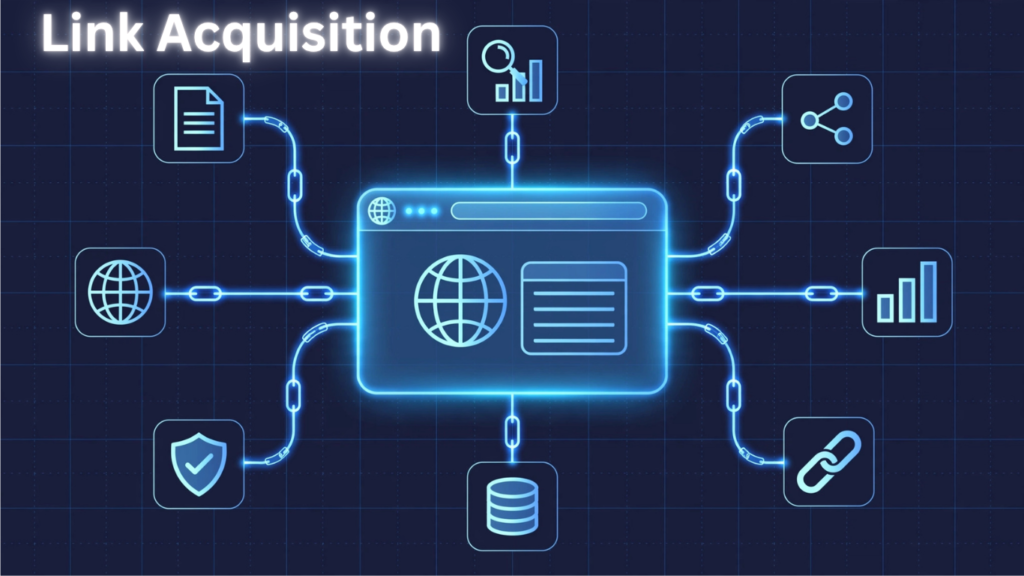
Link acquisition is the practice of obtaining inbound links from other websites through targeted, intentional effort content creation, outreach, digital PR, partnerships, and relationship-building rather than waiting for links to appear on their own.
People often use “link building” and “link acquisition” interchangeably, and in casual conversation that’s fine. But there’s a useful distinction: link building is the umbrella term for the entire discipline, while link acquisition refers specifically to the act of securing the link itself, the outreach email that lands, the resource page that adds you, the journalist who cites your data. It’s the conversion event at the end of a link-building campaign.
Why does that distinction matter? Because it reframes the work. You’re not just “doing SEO” you’re running a small sales funnel where the product is your content and the customer is a website owner, editor, or blogger who has to say yes.
Why Link Acquisition Still Matters in 2026
Search engines have gotten smarter, AI Overviews have changed how people click, and plenty of marketers have started asking whether backlinks still carry weight. They do arguably more than ever, for a few reasons:
- Authority is harder to fake now. As AI-generated content floods the web, search engines lean more heavily on external validation links, mentions, citations to separate genuinely trustworthy sources from content mills.
- Referral traffic has real value. A link isn’t just a ranking signal; it’s a door someone can walk through. A well-placed link on a relevant, high-traffic page sends qualified visitors, not just algorithmic credit.
- AI answer engines cite sources too. Tools like ChatGPT, Perplexity, and Google’s AI Overviews pull from pages that already carry authority signals. A strong backlink profile increases the odds your content gets surfaced and cited in AI-generated answers, not just traditional blue links.
- Competitive gaps are closing elsewhere. As on-page SEO and technical SEO become table stakes, backlinks remain one of the few areas where genuine competitive separation is still possible.
What Makes a Link Worth Acquiring
Not every backlink helps. Some actively hurt. Before chasing volume, filter every opportunity through four questions:
- Is the site topically relevant? A link from a site in or adjacent to your industry tells search engines your content belongs in that conversation. A link from an unrelated site is, at best, neutral.
- Does the site have real authority? Check metrics like Domain Rating (Ahrefs) or Domain Authority (Moz) as a rough proxy — but also look at whether the site has actual organic traffic and a real audience, not just a high score with no visitors.
- Is the placement editorial and natural? A link embedded in a genuinely useful paragraph, written by an actual editor, is worth more than a link dropped into a sitewide footer or a paid directory nobody reads.
- Would this link exist without your involvement, ideally? The best links look like something a human chose to include because it genuinely improved their page not because they were paid to insert it.
A link acquisition strategy built around these four filters will naturally avoid the low-quality, spammy tactics that trigger search engine penalties.
Core Link Acquisition Strategies That Work
1. Build Content Worth Linking To
This sounds obvious, but it’s the foundation everything else sits on. Certain content formats consistently earn links because they solve a problem for the person linking to them, not just for your own audience:
- Original data and surveys — publishing proprietary research gives journalists and bloggers something to cite that doesn’t exist anywhere else.
- Free calculators and tools — anything that saves a reader time or replaces a manual task tends to get bookmarked, shared, and linked to as a reference.
- Definitive, updated guides — comprehensive resources that get refreshed regularly become the “default” link people reach for when they need to cite a topic.
The common thread: this content is created for other publishers to reference, not only for your own visitors to read.
2. Digital PR and Expert Commentary
Reporters and content teams are constantly looking for expert quotes, data points, and commentary to strengthen their articles. Platforms that connect journalists with sources (successors to the old HARO model) let you pitch a short, specific insight in exchange for a citation and link — often from outlets with far more authority than you could earn through outreach alone.
The pitches that get picked up share a pattern: they answer the exact question asked, include a concrete number or specific stance, and arrive within the first few hours of the request going out.
3. Broken Link Building
Every website accumulates dead links over time, old resources that got taken down, competitors that shut up shop, pages that moved without a redirect. Broken link building means finding these gaps on relevant sites and offering your own content as the replacement.
It works because you’re solving a problem the site owner already has (a page with a 404 hurts their own user experience) rather than asking for a favor. Browser extensions and crawling tools can surface broken links on target pages quickly; the harder part is having genuinely comparable content ready to suggest in its place.
4. Resource and “Best Of” Page Outreach
Many niches have curated resource pages hand-picked lists of tools, guides, or organizations relevant to a topic. Getting added to one of these pages is often a lighter lift than guest posting, since you’re not creating new content, just proposing an addition to something that already exists.
Search operators like intitle:”resources” + [your topic] or inurl:links + [your topic] are the fastest way to surface these pages. The pitch works best when it’s short, specific, and explains exactly why your resource fits the existing list, not a generic “please add my site” email.
5. Reclaim Unlinked Mentions
Your brand or content probably gets mentioned somewhere without a link back, a quote in an article, a product name in a roundup, a stat pulled from your research. These are some of the easiest wins in link acquisition because the outreach barrier is already gone; you’re not asking someone to write about you, just to add a link to something they already wrote.
Setting up brand-mention alerts and periodically checking for unlinked citations should be a standing task, not a one-time project.
6. Competitor Backlink Gap Analysis
Run your competitors’ backlink profiles through an SEO tool and look for domains that link to two or three of them but not to you. These sites have already demonstrated a willingness to link to companies in your space; they’re warmer prospects than a cold list you built from scratch. This method won’t invent new opportunities, but it dramatically improves your outreach hit rate.
7. Guest Contributions Done Selectively
Guest posting still works, but the version that moves the needle in 2026 looks different from the mass-outreach guest posting of a decade ago. It means writing genuinely useful, well-researched pieces for a small number of publications your actual audience reads, not spinning the same article fifty times for sites chosen purely by their metrics.
8. Niche Edits on Existing Content
Rather than creating a new page, a niche edit adds your link into an already-published, already-ranking article on a relevant site. Because the host page has existing authority and traffic, the link can start contributing to your rankings faster than a link buried on a brand-new page would. This method should be used carefully and sparingly; it’s one of the tactics search engines scrutinize most closely when the placement looks inserted rather than editorially chosen.
Common Link Acquisition Mistakes
- Chasing metrics instead of relevance. A high Domain Rating from an off-topic site is far less valuable than a moderate score from a site your actual customers read.
- Over-optimizing anchor text. A backlink profile full of exact-match keyword anchors looks manufactured. Natural profiles include brand names, URLs, and generic phrases mixed in.
- Treating outreach as a numbers game. Sending the same templated email to five hundred sites gets a fraction of the response rate of thirty genuinely researched, personalized pitches.
- Ignoring link velocity. A backlink profile that goes from ten links to a thousand in a month draws unwanted scrutiny. Sustainable growth looks steady, not explosive.
- Never auditing existing links. Toxic or spammy backlinks accumulated over time can drag down an otherwise healthy profile if they’re never reviewed or disavowed.
Measuring Link Acquisition Success
Track more than just the raw count of new backlinks:
- Referring domains, not just total links, ten links from ten different domains carry more weight than ten links from one site.
- Organic traffic and keyword movement on the pages receiving new links.
- Referral traffic the links themselves generate, which reflects real audience overlap.
- Domain authority trend over time, as a directional (not absolute) health check.
Building a Sustainable Link Acquisition Process
The sites that keep growing their backlink profiles year over year treat link acquisition as an ongoing operational habit, not a campaign that starts and stops. That usually means:
- A content calendar that regularly produces link-worthy assets, not just blog posts optimized for on-page keywords.
- A standing outreach process even a modest, consistent cadence outperforms sporadic bursts of activity.
- Regular backlink audits to catch both new opportunities and links that need to be disavowed.
- Relationships are maintained with a handful of publishers, journalists, and bloggers in your niche, so future outreach isn’t starting from zero every time.
Link acquisition rewards patience and consistency far more than any single clever tactic. The sites that dominate competitive SERPs today didn’t get there from one viral asset; they got there by treating link earning as a permanent part of how they operate.