Driving traffic to your website is only half the battle. If visitors leave without subscribing, contacting your team, or making a purchase, high rankings alone won’t grow your business.
Many SEO campaigns focus heavily on keywords and rankings while overlooking what happens after someone clicks. Without a structured journey, users arrive, consume a page, and leave. The result is plenty of traffic but very few conversions.
An SEO strategy funnel solves this problem by aligning your content with the way people search, evaluate solutions, and make buying decisions. Rather than creating disconnected blog posts and landing pages, it builds a clear path that guides visitors from their first search to becoming customers.
This guide explains how to build an SEO funnel that attracts the right audience, nurtures trust, and converts organic visitors into leads and sales.
What Is an SEO Strategy Funnel?
An SEO strategy funnel is a content framework that matches search intent with every stage of the buyer’s journey. Instead of treating every visitor the same, it delivers the right information at the right time.
People searching for general information have different needs than those comparing products or looking for pricing. An effective SEO funnel recognizes these differences and creates content that moves users naturally from awareness to purchase.
Rather than focusing solely on rankings, the funnel focuses on outcomes, engagement, leads, and revenue.
Why an SEO Funnel Matters
An SEO funnel creates a structured journey that helps visitors progress from discovering your brand to taking meaningful action.
Whether you operate an eCommerce store, SaaS company, agency, or local business, this approach ensures every piece of content has a clear purpose.
Instead of publishing random articles, you build a connected content ecosystem where each page supports the next step in the customer’s journey.
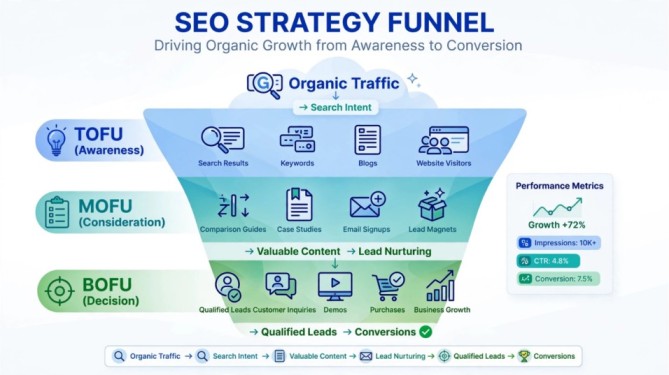
The Three Stages of an SEO Funnel
Every SEO funnel consists of three primary stages that reflect how buyers make decisions.
Top of Funnel (TOFU): Awareness
At this stage, users are researching a problem or learning about a topic. They aren’t ready to buy, they simply want answers.
Goal
Educate visitors and build trust.
Target Keywords
Focus on informational searches, including:
- What is…
- How to…
- Why does…
- Beginner guide…
- Tips for…
Content Types
- Educational blog posts
- How-to guides
- Checklists
- Tutorials
- Industry insights
Example
A digital marketing agency might publish:
“How to Improve Your Website’s SEO in 2026.”
CTA
Invite readers to:
- Subscribe to a newsletter
- Download a checklist
- Read another related guide
Middle of Funnel (MOFU): Consideration
Users now understand their problem and are evaluating different solutions.
They compare products, services, strategies, and providers before making a decision.
Goal
Build credibility and demonstrate why your solution is worth considering.
Target Keywords
Examples include:
- Best SEO tools
- Top CRM software
- SEO agency comparison
- How to choose an SEO consultant
Content Types
- Comparison articles
- Case studies
- Product comparisons
- Expert guides
- Webinars
- Downloadable resources
Example
A SaaS company could publish:
“Top SEO Platforms Compared: Features, Pricing, and Performance.”
CTA
Encourage visitors to:
- Download an in-depth guide
- Book a consultation
- Request additional information
Bottom of Funnel (BOFU): Decision
Visitors have completed their research and are ready to act.
Now they’re searching for pricing, demos, testimonials, and brand-specific information.
Goal
Convert prospects into customers.
Target Keywords
Examples include:
- SEO software pricing
- Buy SEO tool
- Book SEO consultation
- Request demo
- Brand-specific searches
Content Types
- Landing pages
- Product pages
- Pricing pages
- Customer testimonials
- Success stories
- Demo pages
Example
“Start Your Free SEO Audit Today.”
CTA
Use action-oriented calls such as:
- Schedule a demo
- Start a free trial
- Contact sales
- Buy now
SEO Funnel Overview
| Funnel Stage | User Intent | Example Keyword | Content Type | CTA |
| TOFU | Learn | How to improve SEO | Blog, Guide | Subscribe |
| MOFU | Compare | Best SEO software | Comparison, Case Study | Download Guide |
| BOFU | Purchase | SEO software pricing | Landing Page | Start Trial |
Benefits of Using an SEO Strategy Funnel
1. Build a Smarter Content Strategy
Instead of producing content randomly, every page supports a specific stage of the customer journey.
This creates a more organized and measurable SEO strategy.
2. Attract More Qualified Visitors
Intent-focused content brings in users who are genuinely interested in solving a problem, not just browsing.
This improves lead quality and increases conversion potential.
3. Understand the Customer Journey
A funnel helps identify where visitors lose interest.
You can measure which pages generate engagement, where users exit, and which content contributes to conversions.
4. Improve SEO and User Experience Together
A structured funnel naturally strengthens:
- Internal linking
- Site architecture
- Navigation
- Topical authority
Search engines gain a better understanding of your website while users enjoy a smoother experience.
5. Align Marketing and Sales
An SEO funnel gives marketing, sales, and product teams a shared roadmap.
Everyone understands which content supports awareness, evaluation, and purchasing decisions.
How to Build an SEO Strategy Funnel
Step 1: Match Keywords with Search Intent
Group your keywords according to the funnel stage.
TOFU
- How to improve page speed
- What is technical SEO
- SEO basics
MOFU
- Best page speed tools
- Website optimization software
- SEO tool comparison
BOFU
- Website optimization pricing
- SEO audit services
- Book SEO consultation
Create content specifically designed for each group.
Step 2: Audit Existing Content
Review every page on your website.
Ask questions such as:
- Does this page match user intent?
- Which funnel stage does it support?
- Is it generating qualified traffic?
- Does it encourage visitors to continue?
Look for missing content between awareness and conversion.
Step 3: Strengthen Internal Linking
Guide readers naturally through your website.
For example:
TOFU Blog
↓
MOFU Comparison Guide
↓
BOFU Service Page
This keeps users engaged while strengthening your site’s topical relevance.
Step 4: Use Funnel-Specific CTAs
Every page should encourage visitors to take the next logical step.
Examples include:
TOFU
- Download a checklist
- Read related articles
- Join our newsletter
MOFU
- Book a consultation
- Download a case study
- Compare solutions
BOFU
- Request a demo
- Start a free trial
- Contact sales
Avoid asking first-time visitors to purchase immediately if they still need educational content.
SEO Funnel Optimization Checklist
Use this checklist to keep your funnel performing effectively.
- Track traffic by funnel stage.
- Measure conversions from landing pages.
- Monitor engagement metrics like time on page and scroll depth.
- Identify pages where visitors leave the funnel.
- Prioritize search intent over search volume.
- Publish content for every funnel stage.
- Improve internal linking between related pages.
- Review conversion goals regularly in your analytics platform.
Common SEO Funnel Challenges
Content Doesn’t Match Search Intent
Problem: Visitors don’t find the information they expected.
Solution: Create content that directly answers the intent behind each keyword.
Strong Traffic but Weak Conversions
Problem: Plenty of visitors, very few leads.
Solution: Improve landing pages, simplify CTAs, and add customer testimonials or social proof.
Limited Funnel Insights
Problem: You don’t know where visitors leave the buying journey.
Solution: Set up funnel tracking using analytics tools to monitor each stage.
Disconnected Teams
Problem: Marketing, sales, and product teams communicate different messages.
Solution: Build a shared content strategy that supports every stage of the customer journey.
Final Thoughts
A successful SEO strategy isn’t measured by rankings alone, it’s measured by business results.
An SEO strategy funnel connects search intent with meaningful actions, helping visitors move naturally from discovery to decision. By creating targeted content for each stage, improving internal linking, and using relevant calls to action, you build an SEO system that consistently generates qualified leads instead of just page views.
When every page has a purpose, your website becomes more than a source of traffic it becomes a reliable engine for sustainable business growth.
Frequently Asked Questions
How long does an SEO funnel take to produce results?
Most businesses begin seeing improvements in engagement and conversions within three to six months. Results depend on your site’s authority, competition, and consistency in publishing high-quality content.
Is an SEO funnel useful for small businesses?
Yes. Small businesses benefit by focusing their limited resources on content that addresses each stage of the buyer journey, helping them attract qualified visitors and generate more leads.
How often should I review my SEO funnel?
Conduct a complete audit every six months. Regular reviews help you update outdated content, adapt to changes in search behavior, and identify new keyword opportunities.
How does marketing automation fit into an SEO funnel?
Marketing automation complements an SEO funnel by delivering relevant follow-up communications based on user behavior. Awareness-stage visitors can enter educational email sequences, consideration-stage prospects can receive personalized resources, and decision-stage leads can be routed directly to sales, creating a seamless path from organic search to conversion.